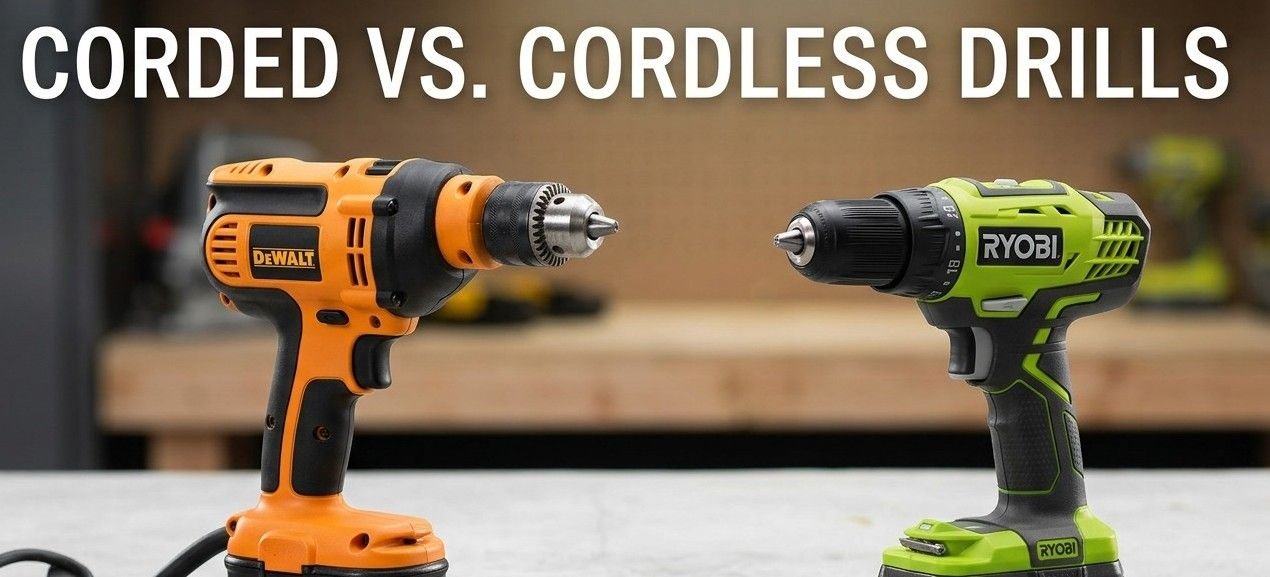
Choosing between a corded drill and a cordless drill comes down to one key question: do you need continuous power or maximum mobility?
A corded drill plugs directly into a wall outlet and provides a constant power supply without the need for recharging. A cordless drill, on the other hand, runs on a rechargeable battery, allowing you to work freely without being restricted by a power cord.
Both tools are designed to drill holes and drive screws into materials such as wood, metal, and masonry. However, the way they deliver power significantly affects their performance, making it important to choose the right option for your specific project.
How a Corded Drill Works?
A corded drill draws electricity directly from a wall socket, supplying the motor with a continuous flow of power. Since there is no battery involved, users do not have to worry about charging, battery life, or power loss during operation.
Most corded drills are rated in watts. Generally, a higher wattage indicates a more powerful motor capable of handling tougher materials and demanding applications. Standard household models typically range from 450 to 600 watts, while heavy-duty industrial models can exceed 1,000 watts for continuous commercial use.
How a Cordless Drill Works?
A cordless drill is powered by a rechargeable battery pack, typically lithium-ion, which fits into the base of the handle and supplies power to the motor.
Cordless drills are rated in volts rather than watts. Entry-level models usually operate at 12V for light-duty tasks, while professional-grade models range from 18V to 20V or higher for increased performance. Many users keep spare batteries charged and ready, allowing them to swap batteries and continue working with minimal interruption.
Corded vs Cordless Drill: Key Differences
The primary difference between corded and cordless drills is their power source. This distinction affects performance, mobility, maintenance requirements, and overall cost.
| Feature | Corded Drill | Cordless Drill |
| Power Source | Wall outlet, continuous power | Rechargeable battery |
| Power Rating | Measured in watts | Measured in volts |
| Mobility | Limited by cable length | Fully portable |
| Best For | Concrete, metal, and extended use | Light to medium-duty tasks and outdoor work |
| Maintenance | Minimal maintenance | Battery replacement required over time |
| Typical Cost | Lower upfront cost | Higher initial investment due to battery and charger |
Runtime for Long Drilling Sessions
One of the biggest advantages of a corded drill is its unlimited runtime. As long as the drill remains connected to a power source, it can operate continuously without interruption. This makes it ideal for projects that require several hours of drilling or fastening.
Cordless drills have improved significantly with advances in battery technology, but runtime is still limited by battery capacity. Modern power tools have benefited greatly from lithium-ion battery innovations, allowing longer runtimes and improved performance.
For extended projects, users often keep two or more batteries on rotation, ensuring one battery is charging while another is in use.
Top Advantages Of Corded Drills
Corded drills hold a clear edge in any situation that calls for sustained heavy duty drilling. Power never drops mid task, so they suit commercial settings where downtime costs money.
- Power supply never runs out as long as the outlet is live, so long jobs finish without interruption.
- Torque output stays consistent, which matters when boring through concrete steel or dense hardwood.
- No battery means a lighter tool body and nothing to recharge between uses.
- Maintenance stays simple because there is no battery health to monitor over the years.
Top Advantages Of Cordless Drills
Cordless drills have closed much of the performance gap thanks to brushless motors and better lithium ion cells. Their biggest strength remains the freedom they offer on any job away from an outlet.
- Complete freedom of movement across job sites, rooftops, and outdoor locations with no outlet nearby.
- No trailing cable, which lowers the trip hazard on cluttered work areas.
- Battery packs are interchangeable across many tools from the same brand, which saves money over time.
- Quick battery swaps keep the workflow moving on most light and medium duty jobs without real delay.
Cost Comparison Between Corded and Cordless Drills
Corded drills generally have a lower upfront cost because they do not include batteries or chargers. This makes them an economical option for users who primarily work in locations with easy access to power outlets.
Cordless drills typically require a higher initial investment due to the cost of batteries and charging equipment. Additionally, batteries eventually lose capacity and may need replacement after several years of use, increasing long-term ownership costs.
For buyers on a limited budget who do not require portability, a corded drill often provides the best value.
Choosing the Right Drill for Your Type of Work
The best drill depends on the type of work you perform and the environment in which you work.
If your projects involve drilling through concrete, steel, or thick hardwood for extended periods, a corded drill offers consistent power without interruptions. If you frequently move between rooms, job sites, or outdoor locations where electrical outlets are not readily available, a cordless drill provides greater convenience and flexibility.
Professionals already invested in a cordless battery platform often benefit from staying within the same brand ecosystem, as batteries can usually be shared among multiple tools.
Power Ratings to Check Before You Buy
Understanding power ratings can help you choose a drill that matches your workload.
Corded Drill Wattage Ratings
For corded drills, wattage indicates the amount of power the motor can deliver. Higher wattage generally translates to better performance on demanding applications.
Cordless Drill Voltage Ratings
For cordless drills, voltage reflects the power potential of the battery system. Higher-voltage models are typically better suited for heavy-duty drilling and fastening tasks.
Choosing a drill with insufficient power can lead to overheating, reduced efficiency, and premature wear.
Conclusion:
Neither drill type is universally better, since each one is built around a different priority that suits a different kind of job.
Corded drills reward you with unlimited runtime and steady power for demanding materials like concrete and dense hardwood. Cordless drills reward you with mobility and convenience for jobs that move around between rooms or sites.
Match the drill to how and where you actually work, and choosing becomes far easier. Power tool solutions provided by Reality BM continue to support contractors, workshops, and DIY users across the UAE with reliable corded and cordless options for every project. Contact our team for expert guidance on choosing the right power drill, brand, and accessories for your specific job.
Keep Reading More Construction & Industrial Guides
- Gypsum Board: Types, Benefits & Uses in Modern Construction: Learn how gypsum boards are used for efficient and modern interior construction.
- Cement Boards vs Gypsum Boards: Which Is Better?: Compare durability, cost, and performance to choose the right material.
- Essential Power Tools Every Handyman Needs in Dubai: Discover must-have tools for efficient construction and repair work.
- What Are Pneumatic Tools & How Do They Work?: Understand how pneumatic tools function and where they are used.
- What Is Glass Wool Insulation? Types, Uses, Benefits & Cost Guide: Complete guide to glass wool insulation, its types, uses, benefits, and costs.