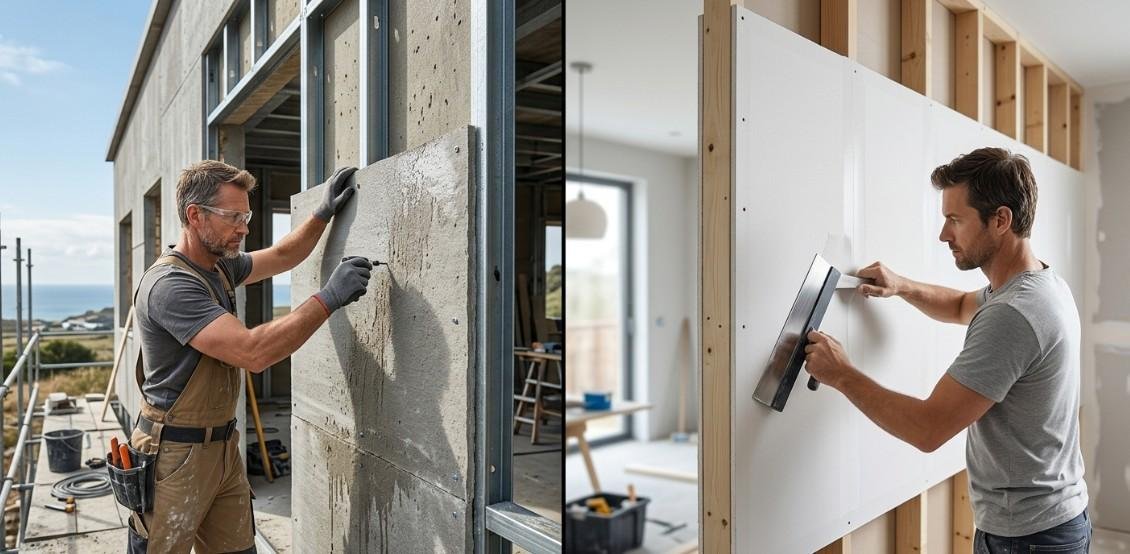
Introduction
Choosing the right building board material is a key decision for construction professionals, contractors, and savvy homeowners alike. Two dominant options in the market are cement boards and gypsum boards, each with distinct performance traits, installation demands, and long‑term implications for project durability and cost.
This comparison guide explains what makes each material unique, helps you match the right board to your application, and enables confident decision‑making.
What Are Cement Boards?
Cement boards are rigid panels made from Portland cement, sand, and reinforcing fibers such as glass mesh. They are engineered to offer enhanced moisture resistance, impact strength, and serve as a stable substrate for heavy finishes like tiles and natural stone. Cement boards are widely used where moisture and durability are major concerns.
Cement Board Structure
Cement board panels contain a high proportion of cementitious material, reinforcing fibers, and occasionally additives such as cenospheres or mica to enhance strength and reduce weight.
They are essentially thin concrete slabs that do not decompose or weaken in the presence of moisture. While not intrinsically waterproof, they resist water damage far better than gypsum boards and do not provide a growth medium for mold.
What Are Gypsum Boards?
Gypsum boards, commonly known as drywall or plasterboard, consist of a gypsum core sandwiched between paper or fiberglass facings. They’re designed for interior walls and ceilings and are known for being lightweight, cost‑effective, and easy to finish with paint, wallpaper, or texture.
Gypsum Board Structure
Gypsum boards are composed of a gypsum core with paper facing or fiberglass mats. The gypsum core contains chemically bound water that contributes to its fire‑resistance properties.
Variants of gypsum board (such as moisture‑resistant, fire‑rated, or sound‑dampening types) exist to meet specific use‑case criteria. However, the gypsum core remains vulnerable to moisture unless specially treated.
Head‑to‑Head Comparison
Durability and Strength
Cement boards are significantly stronger and more rugged than gypsum boards. Their inorganic composition gives them excellent resistance to impacts, warping, and structural stresses, which makes them ideal for high‑traffic or demanding environments. Gypsum boards, while suitable for interior partitions, are more prone to dents, chips, and long‑term wear.
Moisture and Water Resistance
Moisture resistance is the pivotal differentiator: cement boards handle direct water exposure without deteriorating, making them perfect for bathrooms, showers, kitchens, and basements. Gypsum boards absorb water, swell, and weaken if exposed to persistent moisture—standard panels are not waterproof, and even moisture‑resistant gypsum variants have limitations.
Fire Performance
Both materials contribute to fire safety, but they behave differently. Gypsum boards contain chemically bound water, which releases steam under heat to slow flame progress. Cement boards are non‑combustible and withstand high temperatures without structural compromise, giving them an edge in fire‑rated assemblies.
Installation and Handling
Gypsum boards are easier to work with: they’re lighter, cut effortlessly with a utility knife, and fast to install. Cement boards are heavier and tougher to cut, often requiring specialized tools and additional labor. Handling and positioning cement boards often require more manpower, increasing installation time and cost.
Surface Finish and Aesthetics
Gypsum boards provide a smooth canvas ready for finishing with paint, texture, or wallpaper. Cement boards are best used as a structural backer for tile, stone, or masonry, and while they accept finishes, they often need additional surface engineering to achieve polished wall surfaces.
Cost Considerations
Upfront material costs for cement boards are generally higher than gypsum boards, and labor expenses can also be greater due to installation complexity. However, when you factor in lifecycle costs, moisture damage repairs, and durability, cement boards may be more cost‑effective in demanding environments.
Cement Boards vs Gypsum Boards: Key Comparison Table:
| Feature | Cement Boards | Gypsum Boards |
|---|---|---|
| Composition | Portland cement, sand, glass fibers | Gypsum core with paper or fiberglass facing |
| Moisture Resistance | Excellent, suitable for wet areas | Poor for standard boards; moisture-resistant variants exist |
| Durability & Strength | High, impact-resistant, long-lasting | Moderate, prone to dents and chips |
| Fire Resistance | Non-combustible, high heat tolerance | Fire-resistant due to water content, but less durable under high heat |
| Installation Ease | Heavier, requires special tools and labor | Lightweight, easy to cut, fast installation |
| Surface Finish | Substrate for tile or stone; requires extra finishing for smooth surfaces | Smooth, ready for paint, wallpaper, or texture |
| Cost | Higher material and labor costs, but long-term value | Lower upfront cost, cost-effective for dry interiors |
| Best Applications | Bathrooms, kitchens, basements, tile/stone backing, exterior cladding | Dry interior walls, ceilings, fast renovation projects |
| Longevity | High, withstands moisture and structural stresses | Moderate, deteriorates under high moisture exposure |
Specific Use Cases and Applications
Interior Walls and Ceilings
Gypsum boards are the default choice for interior partition walls and ceilings when the primary goals are smooth finishes, quick installation, and cost efficiency. They accommodate paints and decorative treatments well and support finishes like crown mouldings with relative ease.
Wet Areas and Tile Substrates
Cement boards perform exceptionally well as backer boards for tiles in wet spaces. They provide structural support necessary for heavy tiles and resist water intrusion that can compromise standard gypsum boards.
Exterior and High‑Stress Environments
Cement boards are suitable for exterior cladding, facades, and other applications where exposure to weather and mechanical stress is likely. Their ability to resist moisture, heat, and impact makes them suitable for commercial buildings, external wall systems (including EIFS), and high‑traffic areas.
Cost Analysis and Economic Considerations
From a cost perspective, gypsum boards are generally much less expensive per square meter than cement boards. The lower material cost combined with easier installation makes gypsum boards the economical choice for large interior areas where moisture and heavy use are not primary concerns.
Cement boards have a higher upfront cost and increased installation expenses, but their longevity and resistance to damage can lead to lower long‑term maintenance costs, particularly in wet environments where replacement of gypsum boards would be required
Expert Insights and Practical Recommendations
When to Choose Cement Boards
- In wet or damp areas like showers, bathrooms, and laundry rooms
- As a substrate for tile and stone installations
- In spaces demanding long‑term durability and moisture resistance
- For exterior or semi‑exterior cladding that faces humid conditions
Cement boards are engineered for performance where moisture, impact, fire safety, and longevity are top priorities.
When to Choose Gypsum Boards
- For interior walls and ceilings in dry environments
- Where speed of installation and minimal finishing effort are desired
- When cost efficiency and ease of maintenance are priorities
- Applications requiring smooth, paint‑ready surfaces
Gypsum boards excel in traditional residential interiors and commercial spaces where moisture is not a significant concern.
AI Overview
This blog covers Cement Boards vs Gypsum Boards, comparing durability, moisture resistance, fire safety, cost, and best applications to help builders and homeowners make informed choices.
FAQs
What are the main differences between cement board and gypsum board?
Cement board is made of cement and reinforcing fibers, offering superior moisture and impact resistance. Gypsum board is gypsum core with paper facing, ideal for dry interior walls.
Can gypsum board be used in wet areas like bathrooms?
Standard gypsum board is not suitable for wet areas because it absorbs water and can weaken. Moisture‑resistant types are better, but cement board still performs best in wet conditions.
Is cement board more expensive than gypsum board?
Yes, cement board typically costs more per sheet and requires more labor to install due to its weight and specialized cutting tools.
Which board is better for tile installation?
Cement board provides a rigid, stable surface that supports tile and grout, making it preferable for showers and floors. Gypsum board is not recommended for tile backing.
Conclusion
Choosing between cement boards and gypsum boards depends on your project’s environment, load requirements, and long-term goals. Gypsum boards are ideal for dry, interior walls and ceilings due to their cost-effectiveness and ease of installation. Cement boards excel in wet, high-stress, or exterior applications, offering superior moisture resistance, durability, and fire protection.
Selecting the right board ensures structural integrity, reduces maintenance, and enhances the longevity of your construction. For seamless decision-making, practical guidance, and expert recommendations tailored to UAE building standards, Reality Building Materials Trading LLC can help you choose the right solution for your project needs.
Contact a building materials consultant for tailored project advice, specification support, and material selection guidance to ensure optimal performance and compliance.
Explore Related Guides for Tools, Materials, and Industrial Equipment
- What Are Pneumatic Tools & How Do They Work?: Powering Efficiency with Compressed Air Technology.
- The Complete Hand Tools Guide: Types, Uses & Selection: Master every hand tool for precision, safety, and efficiency.
- What is an Air Compressor? Types and Their Industrial Uses: Learn how different air compressors work and their applications in industrial and workshop settings.
- Choosing the Right Fasteners for Your Construction Project: Understand which fasteners suit specific materials and structural requirements.
- Hand Tools vs. Power Tools: Which One Should You Use?: Compare manual and powered tools to select the best option for your projects.