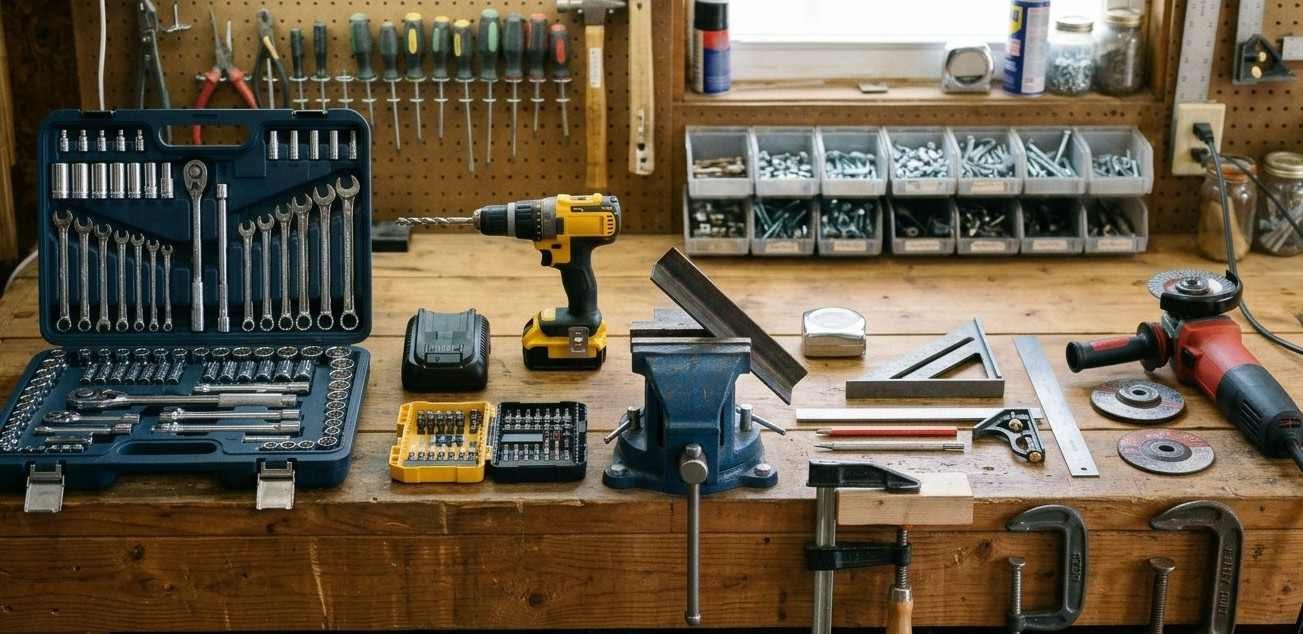
The six essential garage tools every workshop needs are a socket and wrench set, a cordless drill, a bench vise, measuring and layout tools, a set of clamps, and an angle grinder. Together they cover fastening, drilling, holding, measuring, and cutting, which handles most repair and build jobs.
A garage workshop earns its value through the tools inside it. Buy the wrong gear and every project slows down. Buy the right gear and jobs finish cleanly and safely.
This guide covers the essential garage tools worth buying first, why each one matters, and how to choose quality over quantity. It suits home mechanics, woodworkers, and small business owners equipping a shared space.
What Are the Essential Garage Tools for a Workshop?
Essential garage tools are the core items that cover fastening, drilling, holding, measuring, clamping, and cutting. Buying these six first gives you capability for most repairs and builds, and it prevents wasted spending on specialty items you may rarely use.
Think of them as the garage must haves that every other tool depends on:
- Socket and wrench set
- Cordless drill and driver
- Bench vise
- Measuring and layout tools
- Clamps
- Angle grinder
Which Tools Should You Buy First?
Start with the tools you will reach for weekly. This ultimate workshop tools list keeps each item because it solves a problem that no other tool here solves as well.
Why Do You Need a Socket and Wrench Set?
A socket and wrench set tightens and loosens bolts on vehicles, machinery, and shelving frames. It is the most-used item in most garages, so a complete set in both metric and imperial sizes prevents repeated stops at the hardware store.
No list of must have tools for every mechanic is complete without it. Choose chrome vanadium steel with a lifetime warranty, and add a ratchet with a fine-tooth mechanism for tight spaces.
Why Is a Cordless Drill Essential?
A cordless drill and driver bores holes and drives screws without a power cord limiting your movement. An 18-volt model with two batteries and a keyless chuck handles wood, metal, and masonry bits for most household and workshop tasks.
Brushless motors cost more but run cooler and last longer under heavy use. They pay off quickly in a busy home garage.
What Does a Bench Vise Do?
A bench vise holds your workpiece steady so both hands stay free for cutting, filing, or bending. Bolt it to a sturdy bench, because a vise fastened to a weak surface shifts under pressure and defeats its purpose.
Look for cast steel jaws of at least four inches and a swivel base for flexible positioning.
Which Measuring and Layout Tools Matter Most?
Measuring and layout tools include a tape measure, a combination square, and a marking pencil or scribe. Accurate measurements prevent rework, which is the costliest mistake in any workshop because it wastes both material and time.
Precision matters even more in woodworking, where a small error compounds across every joint. Check a new square against a known straight edge before trusting it.
Why Should You Own a Set of Clamps?
Clamps hold glued joints, welded assemblies, and cut pieces in place while you work. A mix of bar clamps, C-clamps, and quick-grip clamps covers most situations, and four of each type is a practical starting point.
They are especially valuable in woodworking, where glued joints need steady pressure while they cure. Add more as your projects grow in size and complexity.
When Do You Need an Angle Grinder?
An angle grinder cuts, grinds, and polishes metal, tile, and masonry using interchangeable discs. A 4.5-inch model with a safety guard suits most garage tasks and stores easily on a shelf or wall hook.
Always wear eye protection, gloves, and hearing protection, and keep the guard in place.
How Do You Choose and Maintain Garage Tools?
Choose tools by build quality, warranty coverage, and how often you will use them, then maintain them with regular cleaning and proper storage. Spending more on daily-use items and less on occasional ones delivers the best return for any workshop budget.
Follow these practices to extend tool life:
- Buy quality for tools you use every week.
- Standardize on one battery platform to avoid mismatched chargers.
- Wipe down and lightly oil metal tools after use.
- Store everything in a dry, organized space.
- Inspect cords, guards, and discs before every job.
Safety deserves equal attention. Review CCOHS guidance on general hand tool operation, and keep a fire extinguisher, a first aid kit, and good lighting in your home garage. A well-equipped garage workshop is only productive when it is also safe.
Final Thoughts on Essential Garage Tools
These essential garage tools form a reliable foundation for repairs, builds, and maintenance. Start with the six listed above, add specialty items as real needs appear, and keep everything organized and in good condition.
Review your current tool list against this guide, and fill the gaps before your next project begins.
Equip Your Garage Workshop with the Right Tools
Ready to stock your garage workshop with socket sets, clamps, vises, and power tools that are built to last? Reality Building Materials Trading LLC, a hand tools supplier in the UAE, can help you choose the right tools for your projects, your workspace, and your budget.
Request a Tool QuoteFrequently Asked Questions
What Is the First Tool to Buy for a New Garage Workshop?
Buy a cordless drill and driver first. It handles the widest range of everyday tasks, from assembling shelves to drilling pilot holes. Add a socket and wrench set second if you plan to work on vehicles or machinery.
How Much Should You Spend on Essential Garage Tools?
A solid mid-range starter kit of the six tools above typically costs a few hundred dollars. Spend more on high-use items like drills and socket sets, and choose budget options for occasional tools like clamps.
Do You Need a Workbench Before Buying Tools?
Yes. A sturdy workbench supports your vise, clamps, and projects safely. Without a stable surface, even high-quality tools perform poorly. Build or buy a bench first, then mount your vise and organize storage around it.