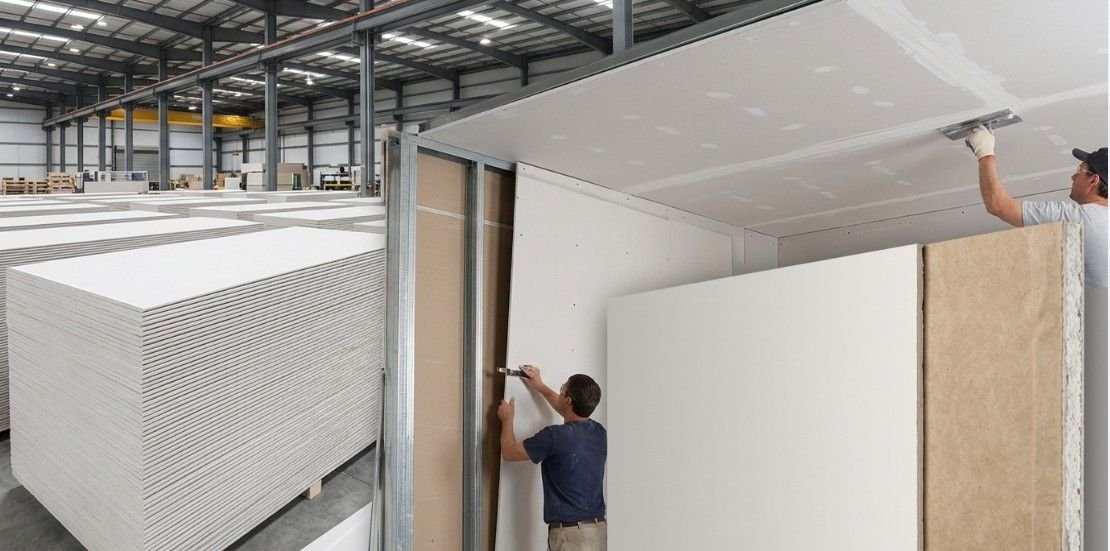
Gypsum board, often referred to as drywall, plasterboard, or wallboard, is a fundamental material in contemporary building construction. It consists of a core made primarily of calcium sulfate dihydrate (gypsum), encased between two layers of paper or fiberglass facing. This configuration results in panels that are versatile, cost‑effective, and suitable for a wide range of interior applications in residential, commercial, and industrial structures.
The material has revolutionized interior construction by replacing traditional wet plaster techniques with a dry construction system that accelerates project timelines, reduces labor, and offers enhanced performance characteristics such as fire resistance, acoustic insulation, and design flexibility.
Composition and Fundamental Properties
Gypsum board is defined by its synthetic structure.
Core Composition
- The primary component is gypsum plaster, a mineral that inherently contains chemically bound water.
- This core is held between paper or fiberglass facings that provide structural stability, surface finish capability, and resistance to handling damage.
Key Material Properties
Gypsum board exhibits several intrinsic properties that make it especially suited to modern construction:
Fire Resistance
Gypsum naturally resists fire because the chemically bound water in its structure evaporates when exposed to heat, slowing the spread of fire and protecting structures. This property makes gypsum board useful in fire rated assemblies.
Thermal Insulation
The material assists in moderating indoor environments by providing thermal mass that slows temperature fluctuations.
Acoustic Performance
Gypsum board helps absorb and dampen sound transmissions, making it valuable in spaces that require noise control such as conference rooms, theaters, and residential units adjacent to high‑traffic areas.
Workability and Finish
It can be cut, shaped, and installed with relative ease and creates a smooth surface ready for finishes like paint, wallpaper, or decorative coatings without extensive labor.
Types of Gypsum Board
Understanding the variety of gypsum board types is essential in choosing the appropriate material for specific construction requirements. Each type has tailored characteristics for performance, environment, and exposure conditions.
Standard Gypsum Board
Description
This is the most widely used gypsum panel for general interior walls, ceilings, and partitions. It provides a smooth finish and is compatible with common surface treatments.
Applications
- Residential and commercial walls
- Ceilings
- Office interiors
Fire‑Resistant Gypsum Board
Description
Enhanced with additives such as glass fibers or non‑combustible materials, fire‑resistant boards offer greater protection against fire spread and contribute to building safety and code compliance.
Applications
- Areas with stringent fire safety requirements
- Commercial corridors and exit paths
- Mechanical rooms
Moisture‑Resistant Gypsum Board
Description
Often identified by green or special coating facings, these boards have improved resistance to water and humidity penetration.
Applications
- Bathrooms
- Kitchens
- Basements
Foil‑Backed Gypsum Board
Description
These boards integrate a reflective foil backing that enhances thermal resistance and reduces heat transfer.
Applications
- Exterior wall linings
- Cold climate installations
Specialized and Impact‑Resistant Boards
Description
Certain gypsum panels are reinforced for high‑traffic or high‑impact environments to reduce surface damage and increase durability.
Applications
- High use corridors
- Commercial buildings
Benefits of Gypsum Board in Modern Construction
Gypsum board offers a range of compelling benefits that reinforce its central role in contemporary building design and execution.
Efficiency and Cost‑Effectiveness
Gypsum board systems are comparatively inexpensive when considering both material and labor costs. They contribute to faster project delivery due to their ease of installation and reduced need for skilled plasterwork.
Fire Protection Enhancement
The inherent fire‑resistant properties of gypsum help building owners meet safety standards without costly supplemental materials. Their use contributes to improved occupant safety and compliance with fire codes.
Acoustic Comfort
Using gypsum board contributes to improved sound insulation in interior partitions, enabling quieter living and working spaces, which is increasingly important in multi‑use and urban environments.
Design Flexibility
Gypsum board supports a wide range of architectural and aesthetic solutions including curved surfaces (with flexible board), detailed ceiling systems, and integrated lighting features.
Sustainability Considerations
Gypsum board production often uses recycled materials, and the product itself can be recycled, reducing waste and environmental impact compared to some alternative materials.
Uses of Gypsum Board in Construction
Gypsum board spans a broad spectrum of applications in modern construction practices due to its performance and versatility.
Interior Wall and Ceiling Systems
Gypsum board is the principal material for interior finishes. It enables smooth surfaces and accommodates paint, wallpaper, or other decorative treatments.
Partition Walls
Lightweight gypsum partitions divide spaces within commercial, institutional, and residential structures. They can be simple non‑load bearing walls or part of more complex fire‑rated assemblies.
Fire‑Rated Assemblies
In multi‑storey buildings and public spaces, gypsum board is used in fire rated wall constructions and shaft enclosures to slow fire spread and enhance safety.
Ceilings and Suspended Systems
Gypsum board forms direct‑attach or suspended ceilings and integrates with lighting and HVAC systems for modern interiors.
Decorative and Custom Architectural Features
With flexible and impact‑resistant variants, gypsum board supports design features such as curved walls, detailed ceiling profiles, and accent panels.
AI Overview
Explore an in-depth guide on gypsum board, covering all types, key benefits, and versatile uses in modern construction. Learn about fire resistance, acoustic performance, moisture protection, cost-efficiency, and design flexibility for residential, commercial, and industrial projects.
FAQs
What is gypsum board used for?
Gypsum board is used for interior walls, ceilings, and partitions, providing a smooth surface for paint and finishes.
Is gypsum board fire resistant?
Gypsum board has natural fire‑resistant properties due to the water in the gypsum core, making it suitable for fire‑rated wall and ceiling applications.
Can gypsum board be used in moisture‑prone areas?
Standard gypsum board is not moisture resistant, but specially treated moisture‑resistant gypsum boards are available for bathrooms, kitchens, and other humid spaces.
Are drywall and gypsum board the same thing?
Yes, drywall, gypsum board, and plasterboard refer to the same panel‑type construction material used for interior walls and ceilings.
Conclusion
Gypsum board has become an essential material in modern construction due to its versatility, cost efficiency, fire resistance, and ease of installation. Its wide range of types including standard, fire resistant, and moisture resistant panels makes it suitable for diverse applications across residential, commercial, and industrial projects. By integrating gypsum board into walls, ceilings, and partitions, builders achieve faster project completion, superior acoustic and thermal performance, and smooth, professional finishes.
For reliable gypsum board solutions, expert guidance, and high quality materials in UAE, Reality Building Materials Trading LLC is your trusted partner for efficient construction support and tailored interior solutions.
Contact our construction experts for professional advice and precise project quotations.
Expand Your Knowledge: Related Industry Guides
- What Are Pneumatic Tools & How Do They Work?: Powering Efficiency with Compressed Air Technology.
- The Complete Hand Tools Guide: Types, Uses & Selection: Master every hand tool for precision, safety, and efficiency.
- What is an Air Compressor? Types and Their Industrial Uses: Learn how different air compressors work and their applications in industrial and workshop settings.
- Choosing the Right Fasteners for Your Construction Project: Understand which fasteners suit specific materials and structural requirements.
- Cement Boards vs Gypsum Boards: Which Is Better?: Comparing durability, cost, and performance to choose the ideal wall and ceiling solution.