Cement-based boards are popular in construction because they offer strength, durability, and moisture resistance. However, cement board and fiber cement board have different compositions and applications. Knowing the difference helps contractors and builders choose the right material for walls, ceilings, floors, wet areas, and façades.
What Is a Cement Board?
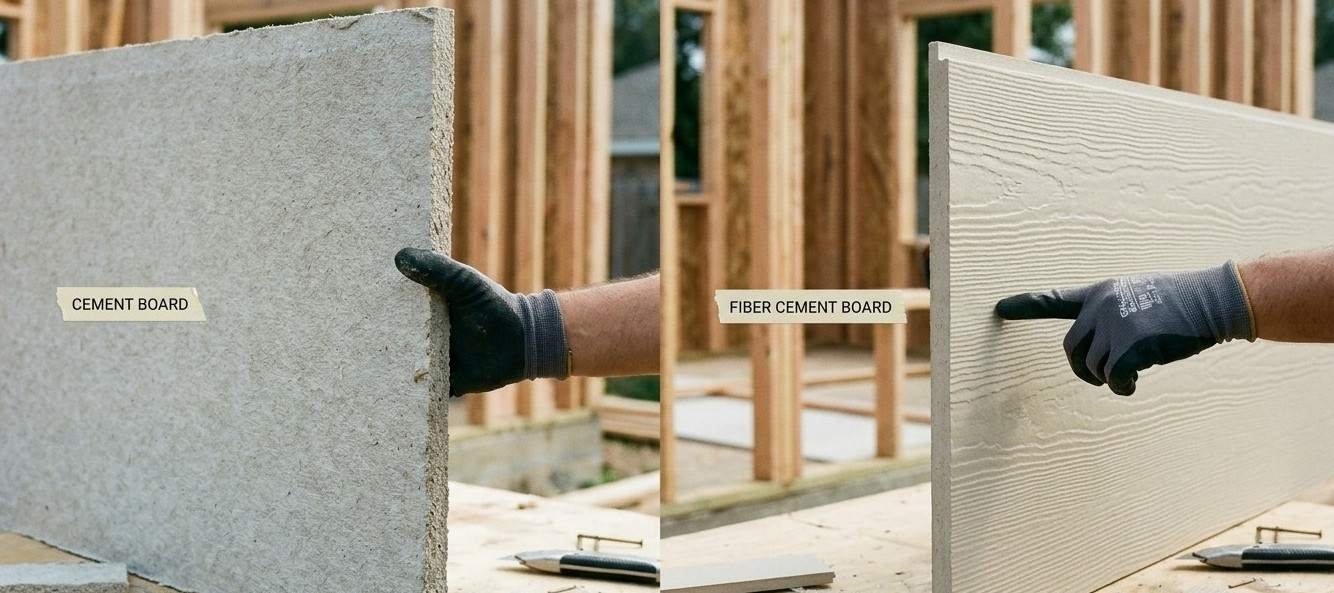
Cement board is a rigid construction panel made primarily from cement and reinforcing materials. Depending on the product, it may contain cellulose, glass, or other reinforcing fibers.
Common cement board applications include:
- Bathroom and shower walls
- Kitchen backsplashes
- Tile underlayment
- Wet rooms
- Flooring substrates
- Wall construction
Cement board is especially useful where a stable and moisture-resistant backing material is required.
What Is Fiber Cement Board?
Fiber cement board is generally manufactured from cement combined with reinforcing fibers and other additives. Cellulose fibers are commonly used, although formulations vary by manufacturer and product.
Depending on the product, fiber cement boards can serve as both a construction panel and an exposed finishing or cladding material.
Typical fiber cement board applications include:
- Exterior wall cladding
- Building façades
- Interior walls
- Ceilings
- Soffits
- Partitions
- Residential and commercial buildings
Fiber cement boards can also be manufactured with different surface textures and finishes, making them suitable for modern architectural designs.
Cement Board vs Fiber Cement Board
| Feature | Cement Board | Fiber Cement Board |
| Composition | Cement and reinforcement | Cement, fibers, and additives |
| Main use | Tile backing and substrates | Cladding, walls, ceilings |
| Moisture resistance | High | High |
| Exterior use | Product dependent | Common |
| Finish | Usually covered | Various finishes available |
| Flexibility | Rigid | Fiber reinforcement improves performance |
The exact properties depend on the manufacturer’s formulation and board thickness.
Composition Differences
The primary difference is the reinforcement used in each material.
Cement board is designed mainly as a rigid, durable substrate. Fiber cement board contains cellulose or other fibers throughout the cement matrix, helping improve strength and crack resistance.
This makes fiber cement panels suitable for applications where the board itself may form part of the finished wall or façade. The fiber reinforcement also helps the panels handle everyday movement and environmental changes more effectively.
Moisture Resistance
Both boards offer excellent moisture resistance compared with standard gypsum drywall. However, moisture resistant does not automatically mean waterproof.
Water can still enter through joints, fasteners, edges, and penetrations. For bathrooms and showers, the board should be installed with the appropriate waterproofing system according to manufacturer recommendations.
For exterior projects, drainage, sealants, flashing, and correct joint treatment are equally important. Choosing a board specifically rated for the intended environment can help prevent premature deterioration.
Which Is Better for Exterior Walls?
Fiber cement board is often preferred for exterior walls because it is available in different textures, profiles, and finishes. It is commonly used for residential siding, commercial façades, and exterior cladding.
Cement boards can also work in exterior applications, but the specific product must be rated for outdoor exposure.
When choosing an exterior cement board, check weather resistance, thickness, fastening requirements, and installation guidelines.
Which Is Better for Bathrooms?
Cement board is widely used as a bathroom wall board and tile backing material. Its rigid structure provides a reliable base for ceramic and porcelain tiles.
Fiber cement board can also be used in bathrooms when the product is approved for humid environments. The best choice depends on whether it will be used as a tile substrate, wall panel, or partition.
Installation Differences
Both materials are heavier and harder to cut than standard drywall. Contractors may need carbide-tipped scoring tools, specialized blades, or suitable power tools.
Proper screws, fastener spacing, joint treatment, and support are important for both products. Always follow the manufacturer’s installation instructions.
Proper handling is also important because cement-based panels can be heavy. Larger sheets may require additional workers during installation. Cutting should be performed with suitable equipment and appropriate safety precautions to control dust.
Cost Difference
The cement board price and fiber cement board price depend on thickness, dimensions, brand, finish, and quantity.
Basic cement boards can be economical for tile backing and interior wet areas. Fiber cement board may cost more when used for exterior cladding or decorative applications.
Consider installation, maintenance, durability, and service life rather than comparing material price alone.
Which One Should You Choose?
Choose cement board for:
- Tile backing
- Bathrooms and wet areas
- Moisture-resistant substrates
- Flooring underlayment
- Rigid wall substrates
Choose fiber cement board for:
- Exterior cladding
- Building façades
- Interior wall panels
- Ceilings and soffits
- Partitions
- Decorative applications
Final Thoughts
The main difference between cement board and fiber cement board is their composition and intended use. Cement board is mainly used as a durable substrate, while fiber cement board provides greater versatility for façades, cladding, walls, ceilings, and architectural applications.
When sourcing materials, reliable cement board suppliers in UAE can help you select the right board based on thickness, application, moisture exposure, and project requirements. Reality Building Materials Trading can assist with suitable construction materials for different project needs. For product availability, specifications, and pricing, contact our team for expert assistance.
Keep Reading More Construction & Industrial Guides
- The Complete Guide to Prefab Construction Materials: See how prefab building systems often combine with glass wool for faster, energy efficient construction.
- What is Vinyl Flooring? Benefits, Types & Uses: Discover a durable flooring option that pairs well with insulated subfloors and walls.
- Asian Paints Berger Suppliers and Dealers in UAE: Explore trusted paint finishes that pair well with insulated walls and interiors.
- Corded Drill vs Cordless Drill: Which One Fits Your Project?: Find the right tool for cutting and fixing glass wool panels during installation.
- MDF vs Plywood for UAE Construction: Which One Is Better?: Compare board materials often used alongside insulation in wall and ceiling systems