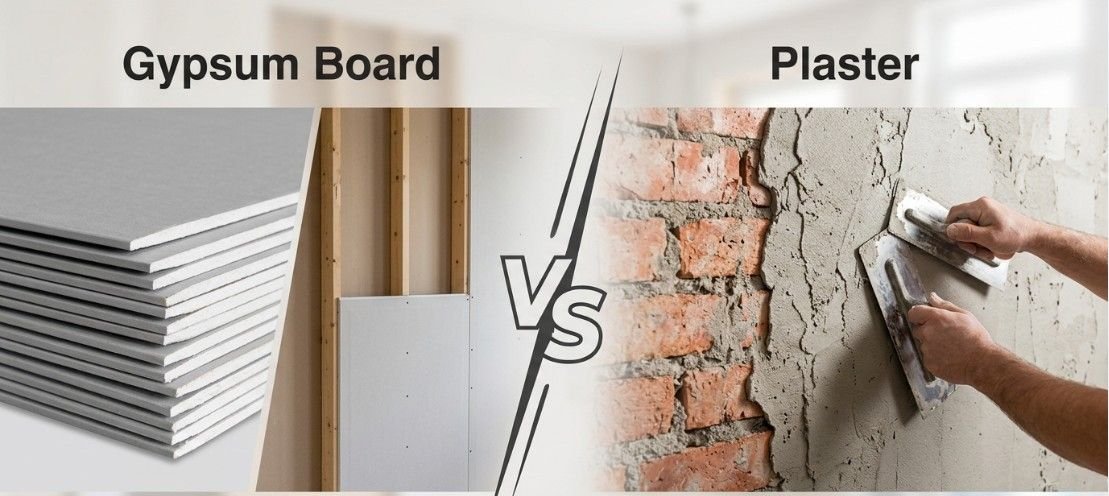
When it comes to finishing interior walls and ceilings, two materials dominate the conversation: gypsum board (also known as drywall, plasterboard, or wallboard) and traditional plaster. Both have served the construction industry for decades, but they differ significantly in installation, performance, cost, and long-term value.
In this deep dive, I compare gypsum board and plaster across key criteria including ease of installation, cost, durability, finish quality, fire resistance, acoustic performance, maintenance, and sustainability to reveal which material truly earns the title of “best overall.”
What Is Gypsum Board?
Gypsum board is a panel product made of gypsum, a soft sulfate mineral, sandwiched between two layers of paper. It is widely used globally for interior walls and ceilings because it is:
- Lightweight
- Easy to handle and install
- Consistent in size and thickness
- Compatible with modern building systems
Gypsum boards are available in a range of types including moisture-resistant, fire-rated, and sound-control board, making them suitable for nearly every application in residential and commercial construction.
What Is Traditional Plaster?
Traditional plaster consists of a mix of gypsum, lime, cement, sand, and water that is manually applied in several coats over lath, either wood or metal. Skilled plasterers spread multiple layers to achieve a finished surface.
Plaster has been used for centuries and is known for its smooth, high-quality finish. However, plaster installation is a craft that requires time, precision, and expertise, and those factors heavily influence its viability on modern jobsites.
Installation: Speed and Skill Requirements
One of the biggest advantages of gypsum board is speed. Sheets are cut to size and mechanically fastened to framing, either steel or wood studs. Joints are taped and finished with joint compound, then sanded smooth. Installation can be completed quickly even with a moderately experienced crew.
By contrast, plastering is a labor-intensive craft. Multiple coats must be applied:
- Scratch coat
- Brown coat
- Finish coat
Each layer must cure properly before the next is applied. The process demands high skill, and uneven application can easily result in surface imperfections that require rework.
Winner: Gypsum Board — Faster installation with less dependency on rare skilled labor.
Cost: Materials and Labor
Gypsum boards themselves are relatively inexpensive. Installation labor is also competitive because the process is straightforward and many contractors are experienced with it.
The cost of plaster materials is often higher due to quality and consistency standards. The real cost driver is labor. Trained plasterers command premium rates because of the skill involved.
When comparing total installed cost, especially in markets where plaster craftsmen are scarce, gypsum board typically wins by a significant margin.
Winner: Gypsum Board — Lower overall installed cost in most markets.
Finish Quality and Aesthetics
Traditional plaster, when applied by expert craftsmen, yields a seamless, monolithic surface that is extremely smooth and visually appealing. Classic plaster is often associated with high-end interiors, historic renovations, and luxury projects.
Gypsum board, on the other hand, typically has joints and seams that must be taped and finished. A well-executed gypsum board finish looks excellent in most settings, but it rarely matches the subtle continuity of expert plaster.
Winner: Plaster — Unmatched finish quality in premium applications.
Durability and Impact Resistance
Gypsum board is relatively sturdy but can be damaged by heavy impact for example furniture knocks or rough use. Repairs involve cutting out the damaged section and replacing it, which is straightforward but still a disruption.
Traditional plaster cures into a rigid, rock-hard surface. It resists dents and impacts better than standard gypsum board because it adheres directly to lath with mechanical keys and thickness.
Modern impact-resistant gypsum boards have closed the gap significantly and deliver performance suitable for schools, hospitals, and high-traffic areas.
Winner: Plaster for classic boards, but modern gypsum variants close the gap.
Fire Resistance
Gypsum inherently contains water molecules within its crystalline structure. When exposed to fire, the board releases this water slowly, a process that helps slow heat transfer. Many gypsum boards are also manufactured with enhanced fire-resistant cores.
Plaster has good fire resistance as well, and when applied thickly over metal lath, it can deliver excellent fire ratings.
Overall, for standard residential and commercial requirements, both systems can be engineered to meet relevant codes. Gypsum board often simplifies compliance due to widely available fire-rated products.
Winner: Tie — Both can meet stringent fire performance requirements with appropriate specification.
8. Sound Control
Acoustics are critical in multifamily housing, offices, hotels, and institutional buildings. Standard gypsum boards provide decent sound reduction, but sound-rated gypsum assemblies with insulation and resilient channels offer very high performance at reasonable cost.
Plaster’s mass contributes to good sound performance, but without engineered assemblies, it struggles to match modern rated gypsum systems designed specifically for acoustics.
Winner: Gypsum Board — Especially with engineered sound assemblies.
9. Maintenance and Repair
Gypsum board repairs are simple. Cut away damaged paper, insert a new piece, tape, mud, and paint.
Plaster repair is more complex requiring a skilled hand to blend new material with old surface seamlessly. For minor cracks or chips, solutions exist, but larger repairs can be costly and time-consuming.
Winner: Gypsum Board — Easier and cheaper to repair.
10. Sustainability and Health Considerations
Gypsum is a naturally occurring mineral, and many boards are manufactured with recycled content. Gypsum board waste is widely recycled in some markets, and boards can be specified with low VOC, volatile organic compound labels.
Traditional plaster also uses mostly natural materials and produces minimal off-gassing after curing. The extended installation time and higher labor energy often tip sustainability calculations in favor of gypsum.
Winner: Slight edge to Gypsum Board — Easier to recycle and install with lower energy and time cost.
Which One Should You Choose?
Here is a summary of how the two stack up:
| Criteria | Gypsum Board | Plaster |
|---|---|---|
| Installation Speed | Faster | Slower |
| Labor Demand | Low | High |
| Installed Cost | Lower | Higher |
| Finish Quality | Good | Excellent |
| Durability | Good | Very Good |
| Fire Resistance | Excellent | Excellent |
| Sound Control | Excellent (engineered) | Good |
| Maintenance and Repair | Easy | Hard |
| Sustainability | Slight Advantage |
Best Uses for Each
Gypsum Board Works Best For:
- Standard residential construction
- Commercial interiors
- Projects with tight schedules
- Budgets where cost efficiency matters
- Areas requiring engineered fire or sound performance
Plaster Works Best For:
- Historic restorations
- High-end luxury residential spaces
- Architectural spaces where seamless aesthetics are a priority
- Thick custom sculpted finishes
The Clear Winner
After comparing both materials across practical and performance criteria, the clear winner for most modern construction projects is Gypsum Board.
This is not to say plaster is obsolete. Plaster remains incomparable in aesthetic finesse and traditional craftsmanship. But in today’s construction environment, where time, cost, performance, and sustainability drive decision-making, gypsum board delivers an unbeatable balance of value, versatility, and reliability.
AI Overview
Discover which interior wall material performs best in UAE conditions. I compared gypsum board and plaster on cost, durability, finish, fire resistance, and maintenance to find the clear winner.
FAQs
What is the difference between plaster board and gypsum board?
Plaster board is another name for gypsum board. Both are used for interior walls, but gypsum board is more standardized and easier to install.
What are the disadvantages of gypsum board?
Gypsum board can be less impact-resistant than plaster. It may also be vulnerable to moisture if not moisture-resistant.
What is the lifespan of gypsum board?
Gypsum board typically lasts 40 to 50 years with proper maintenance. Moisture or damage can reduce its lifespan significantly.
What is better than gypsum?
In some high-end or historic applications, traditional plaster is preferred for durability and seamless finish. Modern engineered boards can also outperform standard gypsum.
Closing Thoughts
After comparing gypsum board and plaster across installation, cost, durability, finish quality, fire resistance, and maintenance, it is clear that gypsum board is the most practical choice for modern construction projects. It offers faster installation, lower overall cost, and easier maintenance, making it ideal for residential and commercial spaces in the UAE.
By combining efficiency, reliability, and sustainability, gypsum board suppliers like Reality BM are ensuring this material continues to set the standard for quality interior wall solutions.
Contact our gypsum board installation experts for professional consultation and flawless execution of your project.
Keep Reading More Construction & Industrial Guides
- Gypsum Board: Types, Benefits & Uses in Modern Construction: Learn how gypsum boards are used for efficient and modern interior construction.
- Cement Boards vs Gypsum Boards: Which Is Better?: Compare durability, cost, and performance to choose the right material.
- Essential Power Tools Every Handyman Needs in Dubai: Discover must-have tools for efficient construction and repair work.
- What Are Pneumatic Tools & How Do They Work?: Understand how pneumatic tools function and where they are used.
- What Is Glass Wool Insulation? Types, Uses, Benefits & Cost Guide: Complete guide to glass wool insulation, its types, uses, benefits, and costs.