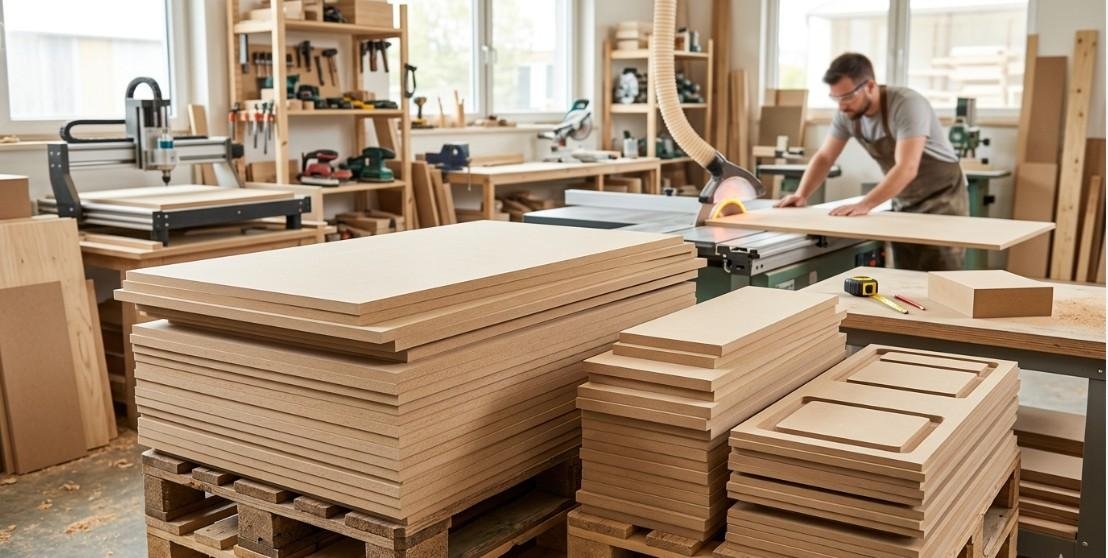
Medium Density Fibreboard, commonly known as MDF, is one of the most widely used engineered wood materials in modern construction, furniture manufacturing, and interior design. It is made by breaking down hardwood or softwood residues into fine wood fibers, mixing them with resin, and compressing them under high temperature and pressure to form dense, smooth sheets.
MDF is preferred in industries where smooth finishing, precision cutting, and cost efficiency are important. According to industry guides, MDF typically costs 30 to 50 percent less than plywood while delivering a superior painted surface quality for interior applications such as cabinets, wall panels, and furniture structures.
What is MDF and Why It is Used
MDF is an engineered wood product designed for controlled performance. It is valued because of three core properties:
- Uniform density throughout the board
- Smooth surface ideal for painting and laminating
- High machinability for cutting, routing, and shaping
Unlike solid wood, MDF does not splinter easily and can be cut in any direction without grain limitations. This makes MDF Boards especially useful in modern furniture production and decorative interior work where precision matters.
Types of MDF Boards Explained
Different MDF variants are designed for specific environments and performance requirements. Choosing the correct type directly impacts durability, cost efficiency, and finish quality.
1. Standard (Plain) MDF Boards
Standard (Plain) MDF Boards is the most commonly used type in residential and commercial interior projects.
It is best suited for dry indoor environments and is widely used due to its affordability and ease of use.
Common uses include:
- Furniture manufacturing such as tables, cabinets, and shelves
- Wall panelling and decorative interiors
- Skirting boards and mouldings
- DIY home projects and modular storage units
Industry studies show that standard MDF dominates interior furniture production because it offers a smooth finish that is ideal for painting and veneering, making it a preferred choice for aesthetic furniture designs.
2. Moisture Resistant MDF (MR MDF)
Moisture resistant MR MDF Boards is manufactured with special resins that reduce water absorption. It is usually identified by its green tint on the edges.
This type is designed for areas exposed to humidity but not direct water contact.
Common uses include:
- Kitchen cabinets, especially under-sink units
- Bathroom vanities
- Laundry room furniture
- Window boards and humid interior zones
Research shows MR MDF performs significantly better than standard MDF in high humidity environments, reducing swelling and structural deformation when exposed to moisture over time.
3. Fire Retardant MDF (FR MDF)
Fire retardant FR MDF Boards is engineered with chemical treatments that slow down ignition and flame spread. It is commonly used in commercial and public infrastructure where fire safety regulations are strict.
Common uses include:
- Hotel interiors and wall linings
- Office buildings and commercial partitions
- Schools, hospitals, and public institutions
- Fire rated doors and ceiling panels
This type of MDF is essential in regulated environments where building codes require materials with enhanced fire resistance performance.
4. Veneered MDF Boards
Veneered MDF consists of a thin layer of real wood bonded to the surface of standard MDF. This creates the appearance of solid wood while maintaining cost efficiency.
Common uses include:
- Premium furniture such as dining tables and wardrobes
- Luxury interior wall panels
- Decorative shelving systems
- Office furniture with natural wood aesthetics
Veneered MDF is widely used in high-end interior design because it combines the visual appeal of natural wood with the stability of engineered boards.
5. Laminated or Melamine MDF
Laminated MDF has a pre-applied decorative coating that eliminates the need for painting or finishing.
Common uses include:
- Kitchen cabinets and modular furniture
- Office desks and storage units
- Wardrobe interiors
- Ready-to-install shelving systems
This type is popular in mass-produced furniture because it reduces finishing time and ensures a consistent surface appearance.
6. High Density Fibreboard (HDF)
HDF is a stronger and denser version of MDF with improved hardness and durability. It is used where strength and wear resistance are important.
Common uses include:
- Flooring underlays
- Cabinet backs and drawer bases
- High-traffic furniture surfaces
- Wall panels requiring extra durability
Industry comparisons show HDF has higher density than MDF, typically exceeding 800 kg/m³, which gives it superior strength and surface smoothness for heavy-duty applications.
Key Benefits of MDF Boards
MDF is widely adopted because it delivers a combination of performance and affordability.
1. Superior Surface Finish
MDF has a smooth and uniform texture, making it ideal for painting and high-quality finishes. There are no grain patterns that interfere with coatings, resulting in a flawless appearance.
2. High Workability
It can be easily cut, drilled, routed, and shaped without splintering. CNC machining is particularly effective with MDF due to its consistent structure.
3. Cost Efficiency
MDF is significantly cheaper than solid wood and often 30 to 50 percent less expensive than plywood, making it ideal for large-scale furniture production.
4. Design Flexibility
It supports a wide range of finishes including paint, veneer, laminate, and printed surfaces, allowing designers to achieve both modern and traditional aesthetics.
5. Uniform Strength
Because MDF is manufactured from compressed fibers, it offers consistent strength throughout the board, reducing weak points commonly found in natural wood.
How to Choose the Right MDF Board
Choosing the correct MDF type depends on your project requirements.
Consider the following factors:
- Location of use (dry or humid environment)
- Strength requirements
- Budget limitations
- Design and finishing needs
- Safety requirements such as fire resistance
For example:
- Use standard MDF for indoor furniture
- Use MR MDF for kitchens and bathrooms
- Use FR MDF for commercial buildings
- Use laminated MDF for ready-to-use furniture
Real-World Applications and Case Insights
In practical industry use, MDF has significantly improved interior design and furniture manufacturing. Modular kitchen makers often use MR MDF for cabinets because it stays stable in humid conditions, while commercial designers prefer FR MDF for office partitions to meet fire safety requirements without losing design flexibility.
In large-scale furniture production, MDF also helps reduce costs by enabling uniform mass production with less waste. Industry studies suggest MDF-based manufacturing can reduce material wastage by around 20 to 30 percent compared to solid wood.
AI Overview
MDF boards are versatile engineered wood materials used in furniture, kitchens, and interiors. This guide explains types, uses, benefits, and helps choose the right MDF for durable, cost-effective projects.
FAQs
What are the different types of MDF boards?
MDF boards include standard MDF, moisture resistant MDF, fire retardant MDF, high density MDF, and laminated MDF.
Which is best, MDF or HDF?
HDF is stronger and more durable, making it better for heavy-duty applications. MDF is more affordable and easier to work with for furniture and interior design.
Which grade of MDF is best?
The best grade depends on usage, but MR MDF is preferred for humid areas. For safety needs, FR MDF is best, while standard MDF works well for general furniture.
What are the 4 types of man made boards?
The main man-made boards are MDF, particle board, plywood, and OSB. Each offers different strength, cost, and application benefits in construction and furniture.
Conclusion
MDF boards have become an essential material in modern construction, furniture making, and interior design due to their versatility, affordability, and smooth finish. From standard MDF for everyday furniture to moisture resistant and fire retardant variants for specialized environments, each type serves a clear and practical purpose. Choosing the right MDF board ensures better durability, improved safety, and cost efficiency across residential and commercial projects.
By combining advanced manufacturing techniques with sustainable material use, MDF solutions provided by Reality BM continue to support high-quality interior and furniture applications while contributing to more efficient and eco-conscious construction practices.
Contact MDF board experts for interior solutions and customized furniture manufacturing to get durable, cost-effective, and project-specific material guidance.
Keep Reading More Construction & Industrial Guides
- Gypsum Board: Types, Benefits & Uses in Modern Construction: Learn how gypsum boards are used for efficient and modern interior construction.
- Cement Boards vs Gypsum Boards: Which Is Better?: Compare durability, cost, and performance to choose the right material.
- Essential Power Tools Every Handyman Needs in Dubai: Discover must-have tools for efficient construction and repair work.
- What Are Pneumatic Tools & How Do They Work?: Understand how pneumatic tools function and where they are used.
- What Is Glass Wool Insulation? Types, Uses, Benefits & Cost Guide: Complete guide to glass wool insulation types, uses, benefits, and cost insights