If you have ever stood in a hardware store staring at a heavy grey sheet wondering what it actually does, you are not alone. Cement board has quietly become one of the most trusted materials on job sites across Dubai and the wider UAE, yet many people still are not sure why builders reach for it so often. Before choosing a board for your next job, it helps to understand what cement boards are and their benefits in modern construction, especially in a climate where heat and humidity test every material you use.
This guide breaks it down in plain language, so whether you are a contractor, a designer, or a homeowner planning a renovation, you will walk away knowing exactly where cement board fits and why it keeps outperforming older alternatives.
What Cement Board Really Is?
Cement board is a flat panel made mainly from cement combined with reinforcing fibers such as cellulose or fiberglass. The fibers are mixed through the cement and pressed into sheets of different thicknesses. This basic composition explains what cement boards are and their benefits in modern construction, since the fiber reinforcement is what gives the panel its strength while the cement core keeps it dense and water resistant.
Unlike gypsum board, cement board has almost no organic material for mold or termites to feed on. That single trait is why it shows up so often behind tiles, under floors, and on exterior walls in humid regions.
How Cement Board Is Made?
There are two common types available in the market, and knowing the difference helps you pick the right one for your project.
| Type | Main Reinforcement | Best Suited For |
| Cement bonded particle board | Treated wood flakes | Higher load bearing walls and floors |
| Cement fiber board | Cellulose fiber | Decorative panels and thinner applications |
Both types share the same fire resistant core, but particle boards generally carry more weight while fiber boards are easier to shape for finer detailing.
Where Cement Board Is Used?
Cement board has moved far beyond bathroom walls. Common applications now include
- Tile backing in bathrooms kitchens and laundry areas
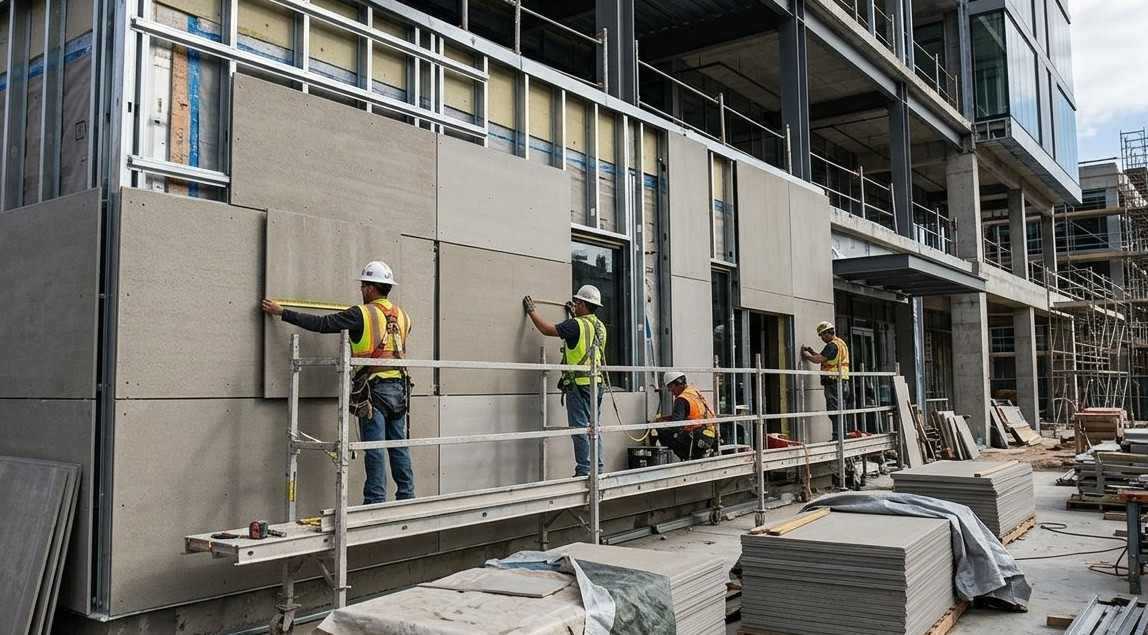
- Exterior cladding and facades that face constant sun and rain
- Flooring underlayment before tile or stone finishes
- Countertop substrates in kitchens and outdoor bars
- Ceiling panels in humid or high traffic buildings
- Soffits duct covering and partition walls
Once you know what cement boards are and their benefits in modern construction, it becomes clear why architects specify them so often in wet areas and exterior applications where other boards simply cannot hold up.
Key Benefits That Make It a Top Choice
Cement board earns its reputation through a handful of properties that matter on almost every project.
- It resists water without swelling or losing strength
- It does not support mold mildew or termite growth
- It holds up against daily impact far better than drywall
- It carries a strong fire resistance rating suitable for schools hospitals and high rise buildings
- It stays dimensionally stable through heat and humidity swings
- It gives tile adhesive a firm surface to bond with, reducing cracked grout later on
These qualities add up to fewer repairs, fewer callbacks, and a longer service life for the finished structure, which is exactly what contractors and property owners want from any building material.
Cement Board Compared With Other Materials
Looking at how it stacks up against drywall and plywood shows exactly what cement boards are and their benefits in modern construction compared with older materials that many builders grew up using.
| Property | Cement Board | Drywall | Plywood |
| Moisture resistance | Very high | Low | Moderate |
| Mold resistance | Excellent | Poor | Poor |
| Fire resistance | High | Moderate | Low |
| Strength after wet dry cycles | Stays strong | Loses strength | Loses some strength |
| Weight | Heavier | Lightest | Moderate |
Drywall is lighter and cheaper, and plywood offers good load bearing support, but neither one matches cement board in wet or fire sensitive areas.
Things to Keep in Mind Before You Buy
Cement board is not without a few practical considerations. It is heavier than drywall, so two people are usually needed to lift and position larger sheets. Cutting requires a carbide tipped blade rather than a standard utility knife, and small gaps should be left between panels to allow for natural expansion. It also has a fairly low insulation value, so additional insulation is often added behind it in exterior walls.
None of these points outweigh its advantages, but planning for them ahead of time saves time and avoids mistakes on site.
Final Thoughts
Now that you know what cement boards are and their benefits in modern construction, the next decision is simply choosing a supplier you can trust for consistent quality. A poorly made board can crack early or fall short of its fire rating, so sourcing from an established supplier matters as much as the material itself.
For quality building materials and construction supplies, Reality Building Materials Trading is a reliable building materials supplier in UAE Dubai, offering cement boards and other construction essentials for projects of every scale. Contact Now to discuss the right boards for your next project.
Keep Reading More Construction and Industrial Guides
- Cement Board vs Fiber Cement Board Key Differences Understand how these two related materials differ before you order for your next job.
- What Is Plywood Its Types Uses And Benefits Guide Compare a common substrate material often used alongside cement board on site.
- The Complete Guide to Prefab Construction Materials See how panel based materials like cement board fit into faster prefab builds.
- Top 10 Benefits of Prefabricated Modular Construction Learn how modern building methods pair well with durable board materials.
- Corded Drill vs Cordless Drill Which One Fits Your Project Find the right tool for cutting and fixing cement board on site.