This guide covers the common types of air hose fittings and how to choose the right size for your application. Learn about thread standards, quick-connect couplers and the key factors that affect airflow, pressure and connection compatibility.
Choosing the right air hose fittings is important for maintaining reliable connections in compressed-air systems. Whether you are connecting pneumatic tools, air compressors or workshop equipment, the fitting must match the hose diameter, connection thread and required working pressure. An incorrect fitting can cause air leaks, restrict airflow and affect tool performance.
This air hose fittings guide explains the common fitting types, sizing methods, thread standards and quick-connect options used in compressed-air applications. It also covers how to match fittings with hose diameter and tool air consumption so you can select suitable components for your system.
What Are Air Hose Fittings and Why Do They Matter?
Air hose fittings are connection components used to join air hoses to compressors, pneumatic tools, regulators, manifolds and other parts of a compressed-air system. They provide a secure connection that allows compressed air to move between equipment.
Choosing the correct fitting helps prevent air leaks, unnecessary pressure loss and connection failures. The fitting must match the hose, connection thread, operating pressure and air demand of the equipment. A fitting that looks suitable may still cause problems if its thread or internal passage is the wrong size.
What Are the Main Types of Air Hose Fittings?
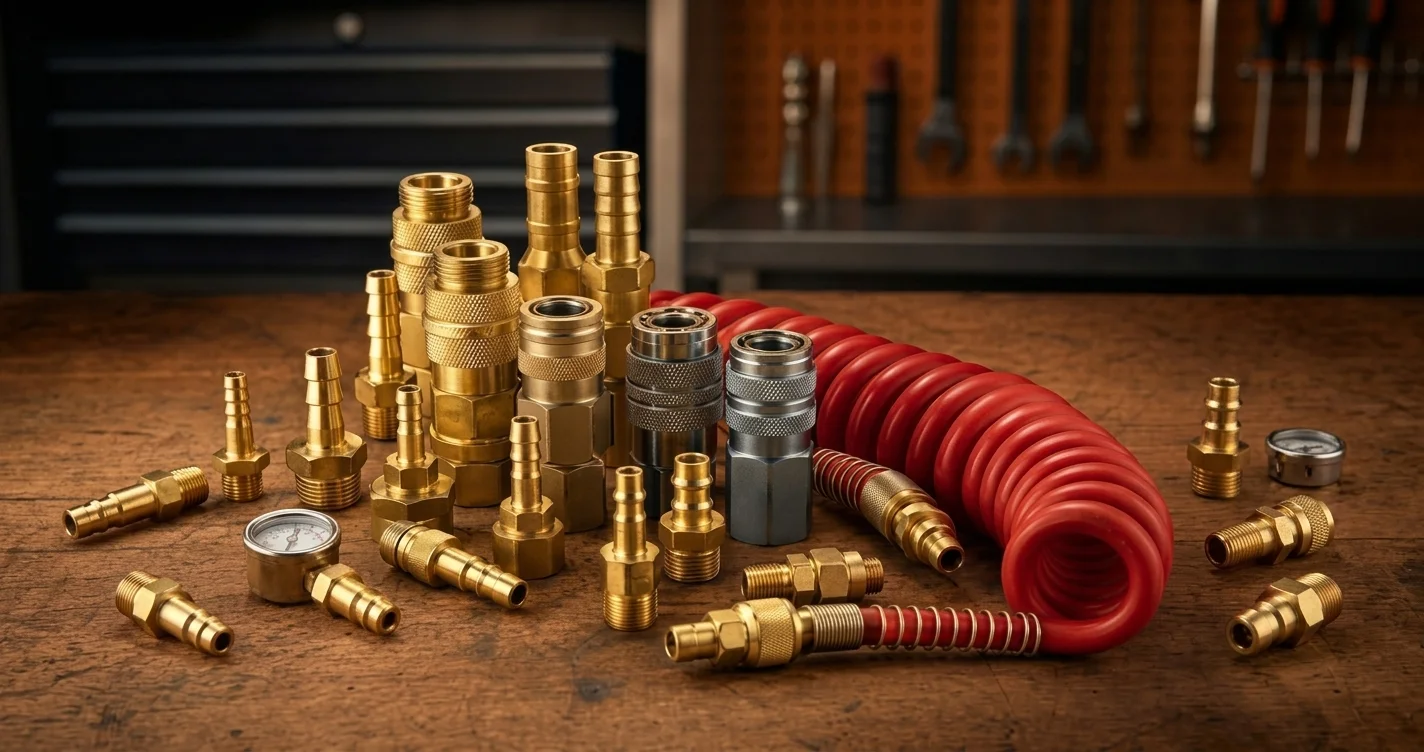
Air hose fittings are available in different designs depending on the hose material, connection method and application. The most common types include hose barb fittings, threaded fittings, quick-release couplers, push-to-connect fittings and adapters.
Hose Barb Fittings
Hose barb fittings have a ridged or grooved end that fits inside a flexible hose. The ridges help grip the hose, while a suitable clamp or crimped connection secures it in place.
These fittings are commonly used with flexible rubber, PVC and other compatible air hoses. The barb diameter must match the hose’s internal diameter. The hose material and fitting manufacturer’s instructions should also be considered when selecting a clamp or securing method.
Threaded Air Fittings
Threaded fittings connect hoses, pipes and pneumatic equipment through male and female threads. They are available in different thread standards and sizes, including NPT, BSPP and BSPT.
Threaded fittings are commonly used at compressor outlets, regulators, valves and tool connections. The thread type must match the equipment port or be connected through a suitable adapter. Similar-looking threads should not be forced together because this can damage the connection or cause leakage.
Quick-Release Couplers
Quick-release couplers allow pneumatic tools and hoses to be connected or disconnected without repeatedly unscrewing threaded connections. A typical arrangement uses a plug on one side and a socket on the other.
They are useful in workshops and industrial settings where operators frequently change tools. However, coupler profiles are not universally interchangeable. Check the plug and socket profile, size, flow capacity and pressure rating before connecting them.
Push-to-Connect Fittings
Push-to-connect fittings secure compatible pneumatic tubing by inserting the tube into a fitting. An internal gripping mechanism holds the tube, while a seal helps prevent air leakage.
These fittings are commonly used with pneumatic control systems and suitable tubing. They should not automatically be treated as replacements for hose barb fittings. Check the fitting’s approved tube material, outside diameter and pressure rating before use.
Adapters, Reducers and Elbows
Adapters connect components that have different connection types or thread sizes. Reducers join different port or passage sizes, while elbow fittings change the direction of an air line.
These components help route compressed-air lines around equipment and confined spaces. Each additional connection can introduce another potential leak point or restriction, so use only the fittings needed for the installation.
How Do You Choose the Correct Air Hose Fitting Size?
Selecting the correct fitting size requires more than checking whether the thread appears to fit. You need to identify the hose’s internal diameter, the equipment’s connection thread and the fitting’s flow capacity.
Use these checks before choosing a fitting:
- Measure the hose inside diameter: For a hose barb, match the barb’s specified size to the hose’s internal diameter.
- Identify the equipment port: Check whether the port uses NPT, BSPP, BSPT or another thread standard.
- Check the coupler profile: For quick-connect systems, confirm that the plug and socket use a compatible profile.
- Review air consumption: Check the pneumatic tool’s air consumption and recommended hose size.
- Confirm the pressure rating: The fitting must be rated for the system’s maximum working pressure and operating conditions.
A hose’s internal diameter and a fitting’s nominal thread size are not the same measurement. For example, a hose with a particular internal diameter may connect to a fitting with a different nominal thread size. Always check both specifications rather than selecting a fitting based on one measurement.
How Do NPT and BSP Air Hose Fittings Differ?
NPT and BSP are different pipe thread systems. They have different thread forms and dimensions, so a fitting from one system should not be assumed to fit or seal correctly with a component from the other.
The main types include:
| Thread Type | Thread Design | Typical Sealing Method |
|---|---|---|
| NPT | Tapered | Thread interference with a suitable sealant |
| BSPT | Tapered | Thread interference with a suitable sealing method |
| BSPP | Parallel | Usually a sealing washer, bonded seal or O-ring at the connection face |
NPT uses a 60-degree thread form, while BSP threads use a 55-degree form. BSPP is parallel, whereas BSPT is tapered. These differences matter when selecting fittings for compressors, regulators and pneumatic tools.
Before purchasing a threaded fitting, check the equipment documentation or manufacturer’s specifications. If the connection standards differ, use an adapter designed for that exact combination. Do not force mismatched threads together.
How Does Hose Diameter Affect Airflow?
Hose diameter affects how easily compressed air can travel from the compressor to the connected tool. A hose with an undersized internal diameter can restrict airflow and contribute to pressure loss, particularly when the tool has a high air demand or the hose run is long.
The required hose size depends on several factors:
- Tool air consumption: Equipment with higher air consumption generally needs a hose and fittings with sufficient flow capacity.
- Hose length: Longer hose runs can increase pressure drop.
- Internal diameter: A smaller passage can restrict airflow, especially under high demand.
- Fitting restrictions: Narrow couplers, adapters and valves can reduce the effective flow area.
- Operating pressure: The system must maintain the pressure required by the tool while it is operating.
Do not select a hose or fitting based only on the compressor’s maximum pressure. Check the tool’s air consumption and recommended hose diameter, then consider the complete air path, including couplers and connectors.
How Do You Match Fittings to Pneumatic Tools?
Different pneumatic tools may have different air inlet sizes, thread types and air consumption requirements. A fitting that works with one tool may not provide sufficient airflow or the correct connection for another.
Before connecting a tool, check its manufacturer’s specifications for:
- Air inlet thread size and type
- Required operating pressure
- Air consumption, usually stated in CFM or L/min
- Recommended hose internal diameter
- Required coupler or connector profile
For example, an impact wrench may need a different airflow capacity from a small pneumatic stapler. The fitting and hose assembly should support the tool’s air demand without creating an avoidable restriction.
What Materials Are Used for Air Hose Fittings?
Air hose fittings are manufactured from different materials to suit their operating environment, pressure requirements and connection type.
| Material | Common Characteristics | Typical Considerations |
|---|---|---|
| Brass | Corrosion resistance and good machinability | Common in general-purpose air connections |
| Steel | Strength and durability | Check the protective finish and operating environment |
| Stainless steel | Strong corrosion resistance | Useful where moisture or corrosive conditions are concerns |
| Plastic or polymer | Lightweight and suitable for specified pneumatic applications | Must meet the required pressure and temperature ratings |
Material selection should consider more than appearance or price. Check compatibility with the hose, compressed-air conditions, operating temperature and manufacturer’s pressure rating.
How Should You Select Quick-Connect Air Fittings?
Quick-connect fittings are useful when tools need to be changed regularly. However, choosing the correct connection involves more than matching the plug’s nominal size.
Check the following details:
- Coupler profile: Confirm that the plug and socket use the same compatible profile.
- Connection size: Match the fitting’s thread or hose connection to the equipment.
- Flow capacity: Make sure the coupler can supply the air volume required by the tool.
- Working pressure: Confirm that the coupler is rated for the system.
- Shut-off arrangement: Check whether the socket has an automatic shut-off valve and how it behaves when disconnected.
ISO 6150:2018 covers dimensions and tolerances for specified cylindrical pneumatic quick-action coupling plugs. It does not mean that every quick-connect design or profile is interchangeable. Always check the product specification before combining components.
What Are the Common Signs of the Wrong Air Hose Fitting?
An incorrectly selected or damaged fitting can affect system performance and create safety risks. Common warning signs include:
| Warning Sign | Possible Cause |
|---|---|
| Air escaping from a connection | Loose fitting, damaged seal or incompatible thread |
| Reduced tool performance | Restricted airflow or insufficient supply pressure |
| Fitting becoming loose | Incorrect thread engagement or unsuitable securing method |
| Cracks or visible damage | Wear, impact or pressure beyond the component’s rating |
| Hose slipping from a barb | Incorrect barb size or inadequate securing |
| Difficulty connecting a coupler | Incompatible plug and socket profile |
If a fitting leaks or becomes damaged, isolate and depressurise the system before inspecting or replacing it. Do not attempt to tighten or disconnect a pressurised connection.
What Should You Check Before Buying Air Hose Fittings?
Before purchasing fittings, confirm that each component is suitable for the intended compressed-air application. A short compatibility check can help prevent incorrect orders and installation problems.
Use this checklist:
- Confirm the hose’s internal diameter and material.
- Identify the correct thread standard and size.
- Check the quick-connect profile, if applicable.
- Review the tool’s air consumption and recommended hose size.
- Confirm the fitting’s maximum working pressure and temperature limits.
- Check the material and seal compatibility.
- Verify that the fitting is designed for compressed-air service.
If you are sourcing components for a workshop or industrial installation, compare the specifications of the hose, fittings, couplers and connected equipment as one assembly. You can explore the available air hose fittings supplier range to review relevant products for your requirements.
How Can You Maintain Air Hose Fittings?
Regular inspection helps identify leaks, wear and connection problems before they affect equipment performance. Maintenance should follow the fitting and hose manufacturer’s instructions.
Keep these practices in mind:
- Inspect fittings, couplers and hoses for cracks, corrosion or visible damage.
- Check connections for air leaks using an appropriate leak-detection method.
- Keep coupler openings clean and free from dust or debris.
- Replace worn seals and damaged fittings with compatible components.
- Avoid pulling or carrying tools by their air hoses.
- Never exceed the pressure or temperature limits specified by the manufacturer.
Always isolate the air supply and release stored pressure before carrying out maintenance or replacing a fitting. This reduces the risk of accidental hose movement or unexpected tool operation.
Conclusion
Choosing the right air hose fittings involves checking hose diameter, thread type, coupler compatibility, airflow requirements and working pressure. Each component must suit the connected hose and equipment. Paying attention to these specifications helps reduce leakage, avoid unnecessary pressure loss and maintain reliable compressed-air connections.
For suitable air hoses, fittings and related equipment, Reality Building Materials Trading LLC provides a range of building and industrial products. Review the product specifications and confirm your application requirements before selecting the components for your compressed-air system.
Find the Right Air Hose Fittings for Your Application
Looking for air hoses, fittings or connectors for your compressed-air system? Reality Building Materials Trading LLC offers a range of air compressor products and related fittings for different workshop and industrial requirements. Contact our team to discuss your product needs.
Frequently Asked Questions
How do I know what size air hose fitting I need?
Check the hose’s internal diameter, the equipment’s thread size and the required coupler profile. Also review the tool’s air consumption and the fitting’s pressure rating before selecting a replacement.
Are NPT and BSP air fittings interchangeable?
No. NPT and BSP use different thread forms and dimensions. Identify the exact thread standard before connecting components. If the standards differ, use a suitable adapter designed for the connection.
Do larger air hose fittings improve airflow?
A larger internal passage can reduce flow restriction, but the fitting must still match the hose, tool and connection. Actual airflow also depends on hose length, operating pressure, coupler design and the tool’s air demand.
Keep Reading More Construction and Industrial Guides
- How to Choose the Right MDF Thickness for Your Project Learn how thickness affects strength and finish, so you pick the right board for your next build.
- Cement Board vs Fiber Cement Board Key Differences Understand how these two related materials differ before you order for your next job.
- What Is Plywood Its Types Uses And Benefits Guide Compare a common building material used across workshops, sites and fit out projects.
- Top 10 Benefits of Prefabricated Modular Construction Learn how modern building methods save time and reduce site waste.
- Corded Drill vs Cordless Drill Which One Fits Your Project Find the right tool for your workshop or site, especially if you also run air tools.